Final of Your Eindhoven of the Future
your eindhoven of the future
a fantastic final at the city hall
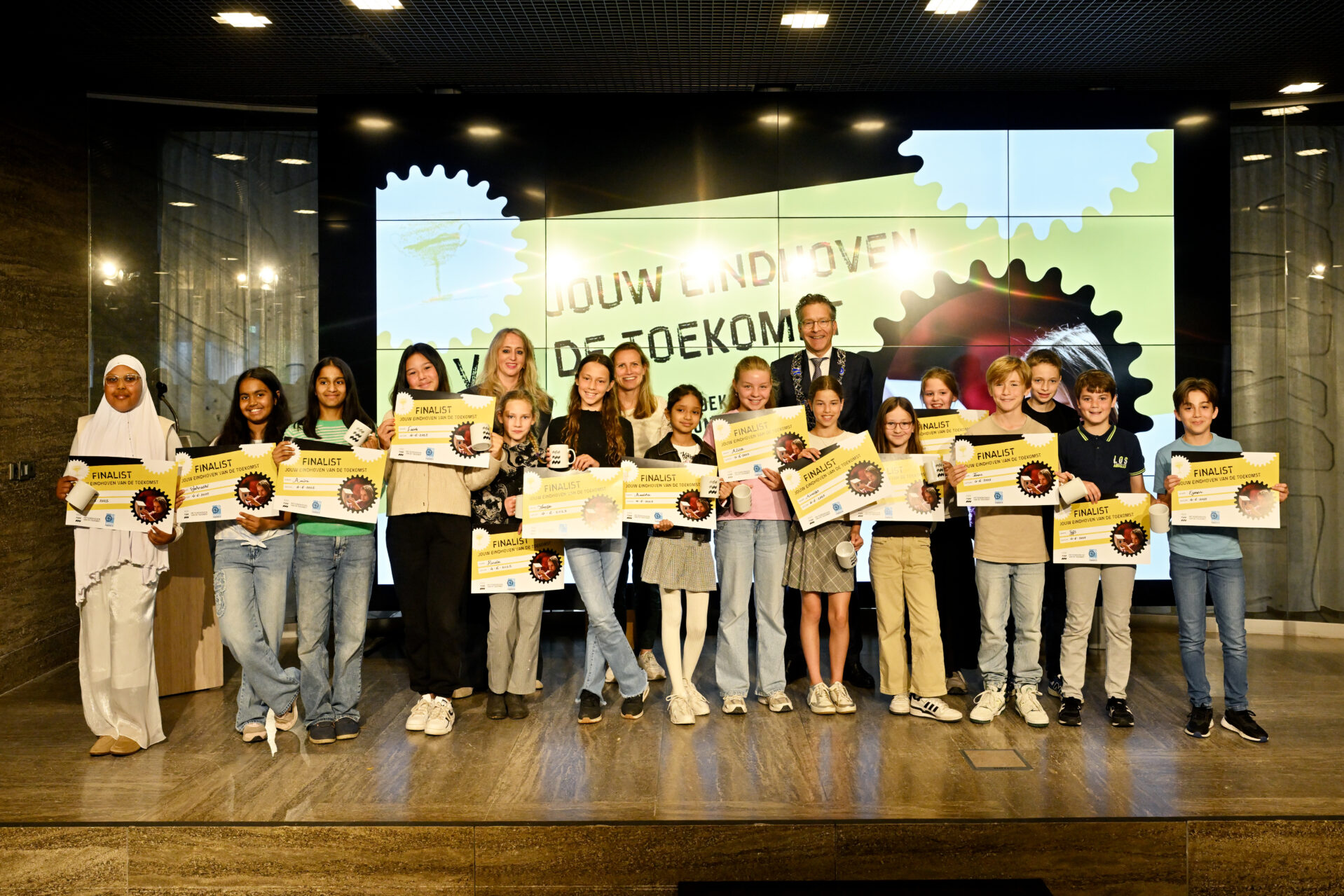
What kind of city do you want to live in in the future? And would you like to help design your city of the future? That was the challenge Mayor Jeroen Dijsselbloem set for children in Eindhoven. Because, as he said during the exciting final on Wednesday 4 June at the city hall: “We talk about the future of Eindhoven in lots of places and with lots of people. But in twenty or thirty years the city will be yours, and that is why your wishes matter most of all”.
During workshops at The Discovery Factory and at their own schools, more than 500 pupils spent the past few months working on their ideas and plans to make the city nicer, more fun, safer, greener and better for everyone in all sorts of ways. They submitted their ideas at www.jouweindhovenvandetoekomst.nl.
At the final in Eindhoven city hall, the inventors of the five very best ideas presented them to their classmates and a three-member jury. Besides Mayor Dijsselbloem, the jury consisted of Suus van Rooijen (strategic adviser at the Municipality of Eindhoven) and Saskia van den Burg (of SDK, developer of neighbourhoods and buildings).
Pupils from the primary schools Tarieq Ibnoe Ziyad, Strijp Dorp, RISE, De Bergen and De Vuurvlinder proudly talked about their plans for their own Eindhoven of the future. Tarieq presented the Culture Library, a two-storey building where people from different backgrounds can meet and get to know each other through all kinds of activities that bring them together. Because, as Amaanah, Samiya and Zeynep put it: “People sometimes have little understanding of each other’s culture”.
Tessa, Floortje and Rosalie from Strijp Dorp primary school explained how they had thought about a child-friendly asylum seekers’ centre for the city, with extra attention for the youngest residents of the centre. There is education, there are all kinds of activities and facilities, and there is “help with things from the war that are hard for the children to cope with”.
A kick up the backside
Vyahruthi, Laura and Amira from the international school RISE came up with the Cleaning Robot 2.0. And it can do it all: the robot cleans the streets, collects lost property, waters the plants and, for example, helps tourists find their way around Eindhoven with a digital map. Mayor Dijsselbloem was happy to add one extra feature: “It would be great if the robot could also give a kick up the backside to people who throw their rubbish on the street”.
Tinus, Gijs, Donny and Eymen from De Bergen primary school were named the winners by the jury. Their Floating Tram is a solution to the growing crowds and traffic problems in the city. The elevated tram is quiet, economical, better for the environment and makes Eindhoven greener and more liveable. When asked for ‘tips and tops’, the jury went suspiciously quiet. The mayor: “I think you did so well that we can’t think of anything”.
Alisa, Babette, Annelies, Anaisha and Sofie from De Vuurvlinder primary school were the last to present at the city hall. ‘The deeper you go, the more boring it gets’ is the name of their plan for the city, in which all the boring things (like cars and schools) move underground and fun things, like swimming pools and football pitches, get all the space above ground. The five girls collected the most votes online (114!) for their design and so won the public prize. Just like the class from De Bergen, their whole class gets to enjoy a Maak het Mee workshop at The Discovery Factory.
Top 040
Mayor Dijsselbloem was impressed by all the plans and presentations. “Grown-ups are sometimes very shy, but you certainly aren’t.” One pupil in the audience still wanted to know what will now happen with all the ideas. A good question, the mayor thought: “We will take them to the final round of ‘The Eindhoven of the Future’, and the forty best ideas will become our ‘Top 040’. Next year there are municipal elections again, and hopefully the parties will then use all the ideas for their plans.”
Sponsors of The Discovery Factory
Sponsors who know that whoever has the youth, has the future.